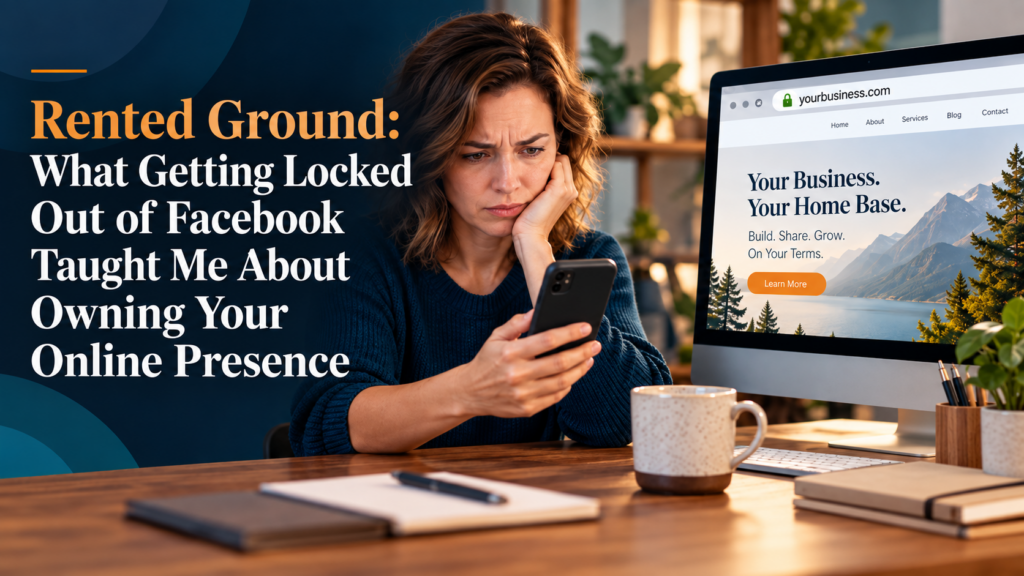
I’ve been building websites for over 25 years, and I’ve spent much of that time telling clients the same thing: don’t build your business on ground you don’t own. This month, I got a firsthand reminder of why.
What Happened
My personal Facebook account was suspended. I hadn’t posted anything offensive or broken any rules I know of. What I did was set up an automation, using a tool called IFTTT, to post daily event updates to the business pages of 11 of my clients. It’s the kind of routine work any marketing person does to keep a business visible: same events, same pages, posted on schedule.
Facebook’s systems flagged it. The account went down, and a few days later I got to “appeal.” The appeal was one button. I pushed it, waited, and got a denial. No explanation, no reasoning, no phone number, no email, no person. Just a decision from a system, delivered without a word about what triggered it.
If you run a business page, that should get your attention. Here’s why.
Your Business Page Hangs on a Personal Account
Here’s what many business owners don’t realize. To create and manage a Facebook business page, you have to log in through a personal profile. Your business presence is attached to a person’s account, and if that account gets flagged, suspended, or disabled, the pages tied to it can be caught in the fallout.
That means the safety of your business marketing depends on whether an automated system decides one person’s account looks suspicious on a given day. It could be you, your marketing person, or your web guy. Any of us can get flagged, and when we do, you don’t lose a post. You can lose access to the place where your customers find you.
How Quickly It Can Happen
I wasn’t doing anything shady. I was posting real events for real businesses on a schedule. But automated posting to multiple pages from one account can look, to an algorithm, a lot like spam. The system doesn’t know that these are legitimate clients, that each post is accurate, or that a real business owner asked for it. It sees a pattern and acts.
That’s the part that stings. A completely legitimate use of the platform, the sort of thing agencies and small business owners do every day, can get an account suspended in a flash. And you may never find out what specifically set it off.
Automation Without Accountability
I understand why Meta uses automated systems. They’re dealing with billions of accounts, and a huge amount of spam, scams, and fake profiles. Nobody expects a human to review every post.
But automation with no accountability is a different thing. Any fair process has a few basics:
- A clear explanation of what rule was broken
- A real way to speak with a human being
- An appeal that involves someone actually reviewing the facts
What I got instead was a button. Push it, wait, and hear “no.” That isn’t an appeals process. It’s a formality.
For a person posting vacation photos, that’s frustrating. For a small business owner whose customers, reviews, and event announcements live on that platform, it can hurt real income.
Where’s the Business-First Option?
Here’s what really gets me. Meta makes a great deal of money from businesses. Advertisers and business page owners are a huge part of the company’s revenue. Yet the business side of the platform is still built on top of personal accounts.
Why isn’t there a true business-first option? A business account with its own login, its own security, and its own support channel, fully separate from anyone’s personal profile. That’s how the rest of the business software world works. Nobody makes you log into your bank, your accounting software, or your payroll system through your personal social media profile.
Meta has introduced some business tools and login options over the years, and some help. But in my experience, the core problem remains: the tie between personal accounts and business pages is still there, and when things go wrong, the support isn’t. Paid support options exist for those who pay, but a small contractor shouldn’t have to pay a monthly fee just to reach a human being when an algorithm makes a mistake.
This Is Why You Need Ground You Own
I’m not telling you to quit Facebook. It’s a useful tool, and a lot of customers spend time there. Use it. Just don’t let it be the foundation.
Think of it this way. A social media page is like setting up a booth on someone else’s property. You can do good business there, but the landlord makes the rules, can change them any time, and doesn’t have to explain if they ask you to leave.
Your website is your own building, on your own lot. Consider what that gets you:
- You control it. Nobody can suspend your website because an algorithm had a bad day.
- You own the content. Your photos, your project galleries, your customer reviews, and your service pages stay yours.
- You show up in search. When somebody in your town searches for what you do, your website is what Google shows them, including in the map results for the towns you serve.
- You own the relationship. A contact form and an email list mean you can reach your customers without asking a platform for permission.
For a contractor, a landscaper, or a small shop, this comes down to a simple fact: if your customers can only find you on a platform you don’t control, you’re one automated decision away from being invisible.
What To Do About It
If your business is leaning heavily on a social media page, here’s a straightforward game plan:
- Make sure your website is the hub. Everything on social media should point back to it.
- Have more than one admin on your business pages, so no single personal account is a single point of failure.
- Keep a copy of your content. Photos, event info, and posts should live somewhere you control, not just on the platform.
- Build an email or contact list of customers you can reach directly.
- Be careful with automation. Scheduled posting can be useful, but know that platforms can treat automated activity as suspicious, even when it’s legitimate.
The Bottom Line
Social media is a great place to visit and a poor place to live. I learned that the hard way, and I’d rather you learn it from my mistake than your own.
If you’d like a website that belongs to you, one that works on a phone at a job site and shows up when your neighbors search for your services, give me a call. No jargon, no runaround, and you’ll always be able to reach the person who built it.
David Turner Designs, Bessemer City, NC