
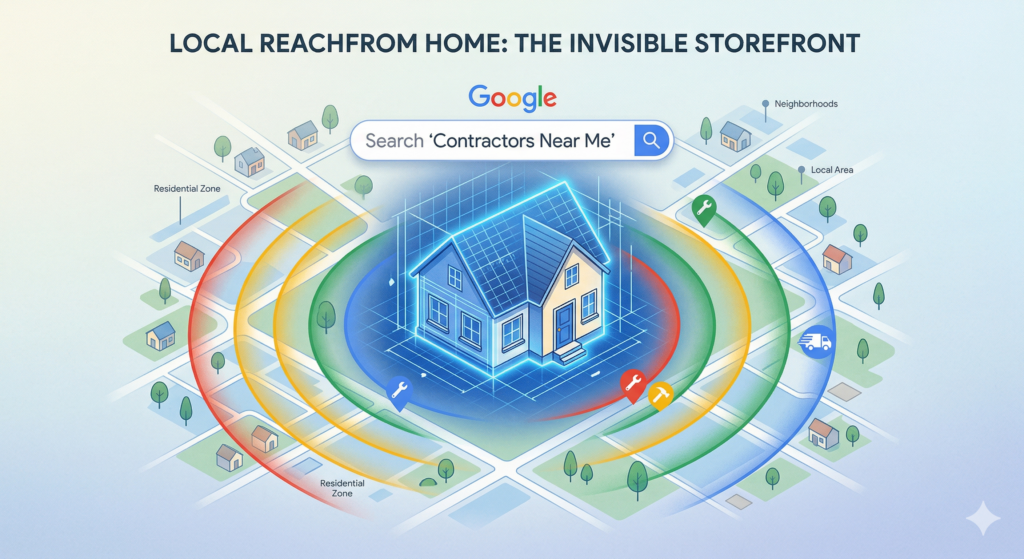
For home-based contractors and service-area pros, the biggest “local SEO” fear is often the same: “If I don’t have a shop on Main Street, will customers even find me?”
The short answer is yes. In 2026, Google has refined its “Service Area Business” (SAB) model to ensure that quality contractors aren’t buried just because they work out of a home office. However, there are specific “rules of the road” you must follow to stay visible and avoid the dreaded profile suspension.
The Service Area Model: Hiding the House, Showing the Work
When you set up your Google Business Profile (GBP), you have the option to tell Google: “I visit my customers; they don’t visit me.” By selecting “No” when asked if you have a location customers can visit, you unlock the Service Area feature. Instead of a red pin at your house, Google shows a shaded “service area” on the map.
- The Strategy: You can list up to 20 service areas (cities, zip codes, or counties).
- The Guardrail: A smart rule of thumb is to keep your service area within a 2-hour drive (about 100 miles) of where you live. Going too broad looks like “spam” to Google and can actually hurt your rankings.
The Proximity Bias: Knowing Your Limitations
It’s important to be realistic: Google still prioritizes proximity. If someone is standing in downtown Charlotte searching for a “Handyman,” Google will likely show the guy with a physical shop 2 blocks away before it shows a home-based pro in Bessemer City—even if the Bessemer City pro has better reviews.
The Limitation: You are effectively “anchored” to your home address, even if it’s hidden. You will always rank strongest closest to home.
The “Website as Hub” Counter-Attack
How do you beat a competitor who has a physical storefront? You out-authority them. This is where your Website as Hub becomes your secret weapon.
While the storefront competitor relies on their physical location, you can use your website to signal “relevance” to Google’s AI.
Town-Specific Landing Pages: Don’t just say you serve “The Greater Charlotte Area.” Create a page for “Electrical Services in Gastonia” and another for “Contracting in Kings Mountain.”
The “Atomic Answer” Strategy: Google’s AI now pulls snippets directly from your site into the Map Pack. If your website has a clear FAQ section like “What is the best way to handle old wiring in Gaston County homes?”, Google is more likely to feature your “Invisible Storefront” because you’ve provided the best answer.
Visual Proof: Since people can’t see your shop, they need to see your work. Uploading geotagged photos of your jobs in specific neighborhoods directly to your Google Profile tells the algorithm: “I am physically active in this area right now.”
The Bottom Line for 2026
A physical address is a “location signal,” but consistent activity is a “trust signal.” By treating your Google Profile like a daily micro-blog and your website as the strategic “Hub,” you can effectively neutralize the advantage of the guy with the expensive downtown lease.