If you run an HVAC company, own a landscaping operation, manage a restaurant, or keep any kind of small brick-and-mortar shop open in the Carolinas, I want to talk to you about something that happened at Google’s big annual conference a few weeks ago — because most of the coverage has been aimed at tech people, and what it means for a business like yours is getting lost in the noise.
Here’s the short version: Google just announced the biggest change to how search works in 25 years. And while it’s not a reason to panic, it is a reason to pay attention and make a few moves right now rather than later.
Let me break it down in plain terms.
What Google Actually Changed
For as long as most of us can remember, Google search worked the same basic way. You typed something in, you got a list of links, and you clicked on the one that looked most useful. Those clicks sent people to websites — including yours.
That model is changing fast.
What Google rolled out at their I/O 2026 conference is something they’re calling “AI Mode” — a complete redesign of search built around artificial intelligence that tries to answer questions directly, right on the Google results page, without sending the person anywhere.
Think of it this way: instead of acting like a phone book that points you to businesses, Google is trying to become the person who just answers your question for you. And that means fewer people ever clicking through to your website.
Real stat: 60% of all Google searches now end without a single click to any website.
For “near me” type searches — the exact searches your local customers use — that number is as high as 78%.That’s not a typo. Nearly 8 out of 10 local searches end with the customer getting information directly from Google, without visiting anyone’s site.
So What’s the Real Risk for a Contractor or Small Shop?
Here’s where I want to be careful not to oversell the scare factor, because the actual risk for local businesses is different from what’s hitting big national publishers right now.
The companies getting absolutely crushed by this change are places like HubSpot — giant websites that depend on millions of strangers finding their blog posts through Google. Those businesses are seeing traffic drop 70–80%. That’s catastrophic for them.
Your HVAC company or your downtown sandwich shop doesn’t live and die by blog traffic. So the immediate damage is different. But here’s where it does affect you:
- AI is now deciding who gets recommended.
When somebody asks Google — or ChatGPT, or any AI tool — “Who’s the best roofer near Gastonia?” or “Is there a good pizza place in Bessemer City?”, the AI gives them an answer. It picks a handful of businesses to name. Maybe three. Maybe five.
If you’re not on that short list, you don’t exist in that conversation.
And the way you get on that list is different from the old way of ranking on Google.
- Your review rating is now a hard filter.
This one matters a lot. ChatGPT won’t recommend a business with less than a 4.3-star average. Perplexity cuts off at 4.1 stars. Gemini at 3.9.
Google Maps used to rank you if you had 3.5 stars and were nearby. AI tools don’t work that way. They apply a quality filter before they’ll even mention you. If you’ve been coasting on a 3.7 average and haven’t actively worked on getting fresh reviews, there’s a real chance AI search is skipping over you entirely.
- The people who DO click through are more serious buyers.
Here’s the silver lining, and it’s a real one. The people who click through to your website after seeing an AI summary have already done some research. They’re not just browsing — they’re closer to making a call or placing an order.
The data backs this up: click-through traffic from AI search converts at roughly 14%, compared to about 3% from traditional Google organic search. Fewer visits, but better visits.
So your goal shifts from “get as many clicks as possible” to “make sure the right people can find you and trust what they see.”
What You Should Actually Do Right Now
None of this requires a huge budget or a complete overhaul. Most of it is stuff you can do — or that I can help you with — without reinventing your business. Here’s where I’d focus:
Treat Your Google Business Profile Like Your Most Important Web Page
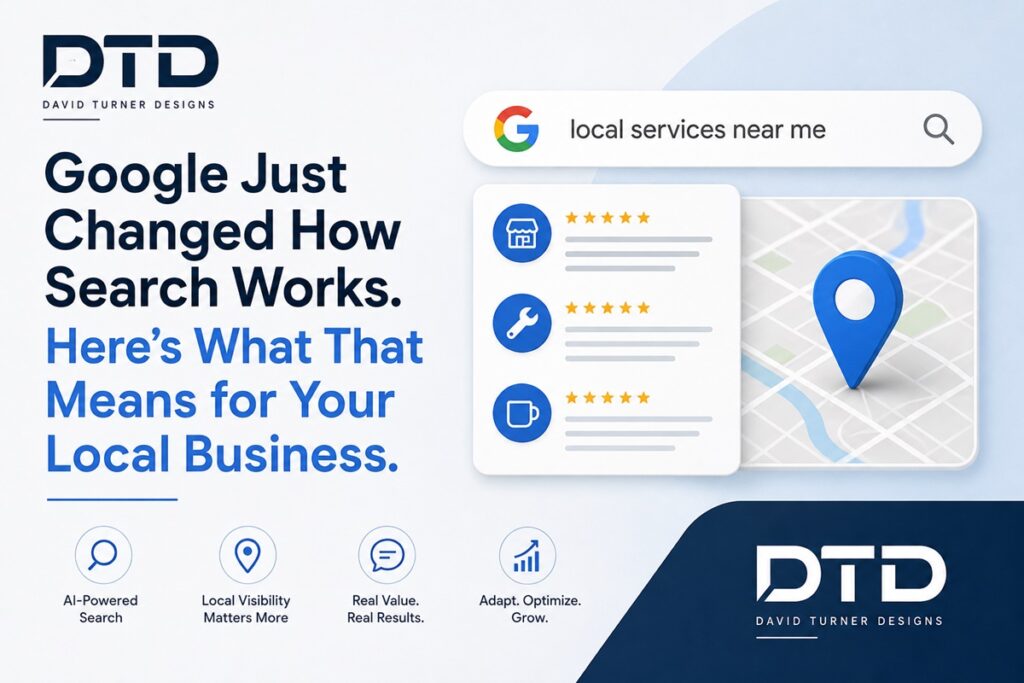
Your Google Business Profile — the listing that shows up in the map and the sidebar when someone searches for your business — is now more important than your website for a lot of searches. It feeds the AI. It’s where reviews live. It’s where your hours, photos, and service list appear.
If yours hasn’t been updated in a while, that’s the first thing to fix. Make sure every service you offer is listed. Add recent photos. Keep your hours accurate. Respond to reviews — all of them, good and bad.
Get Serious About Your Review Average
I know asking for reviews feels awkward. Do it anyway. Text your recent customers. Ask after a job well done. Make it easy — send them a direct link to your Google review page.
Your target is a 4.3-star average or better. Below that, you’re at risk of being invisible to AI-powered search. Above it, you’re in the conversation.
If you have some old negative reviews dragging your average down, a steady stream of new positive ones is the most reliable way to move that number.
Make Sure Your Website Is Clean and Organized
Your website is still how AI tools learn what you do, where you operate, and whether you’re worth recommending. A slow, cluttered, or outdated site sends the wrong signal.
At a minimum, you want:
- A separate page for each service you offer (not one page that lists everything)
- Your service area clearly stated — town names, county names, not just a zip code
- Your phone number and address consistent across your site and your Google listing
- A site that loads fast on a phone, because that’s how most of your customers are searching
Stop Measuring Success by Website Traffic Alone
This is a mindset shift, but it’s important. If your analytics show fewer website visitors than two years ago, that doesn’t necessarily mean your marketing is failing. It might mean people are calling you directly from Google without ever visiting your site first.
The numbers that matter are calls, form submissions, foot traffic, and revenue. Track those. If those are healthy or growing, your digital presence is doing its job — even if raw traffic looks flat.
Don’t Put All Your Eggs in the Google Basket
This has always been good advice, but it matters even more now. Google is increasingly keeping people inside Google. That means you want some presence that lives outside of it.
For a contractor or local shop, that doesn’t have to be complicated:
- A Facebook page with regular, genuine posts goes a long way in a local community
- An email list of past customers is gold — you own that, Google can’t touch it
- Nextdoor is underrated for neighborhood-level service businesses
- Asking happy customers to tell their neighbors — old school, still works
The Big Picture
Search isn’t dead. Google isn’t going away. But the relationship between a search engine and a local business has shifted in a meaningful way, and the businesses that adapt early are going to have an advantage over the ones who wait until the effects are impossible to ignore.
The good news is that the fundamentals haven’t changed: do good work, get good reviews, show up professionally online, be easy to reach. What’s changed is which of those things matter most right now, and how the tools around them work.
You don’t need to become a digital marketing expert. You need someone in your corner who is one — and who can translate what’s happening in the tech world into practical steps for a business like yours.
The contractors and shop owners who will win in this environment are the ones with solid review ratings,
a clean and well-organized website, an active Google Business Profile, and some presence outside of Google.
That’s not a massive undertaking. It’s a smart one.
Not Sure Where You Stand?
If you’re not sure how your business looks to AI search tools, or if you haven’t revisited your Google presence in a while, let’s just have a conversation. No pressure, no sales pitch — just a plain-talk look at where you are and what, if anything, makes sense to do next.
Reach out anytime at davidturnerdesigns.com or give me a call. I’m always happy to talk through what’s going on and what it means for your specific business.