Updated November 2026. This guide combines my two posts on what Google announced at its I/O 2026 conference, so it’s all in one place.
If you run an HVAC company, a landscaping crew, a restaurant or any small shop in the Carolinas, the biggest change to Google search in 25 years is already affecting you. Most of the coverage has been aimed at tech people, so here is what it means for a business like yours, in plain terms, and the few moves worth making now.
What Google actually changed
For as long as most of us can remember, Google worked one way: you typed something, you got a list of links, and you clicked one. Those clicks sent people to websites, including yours.
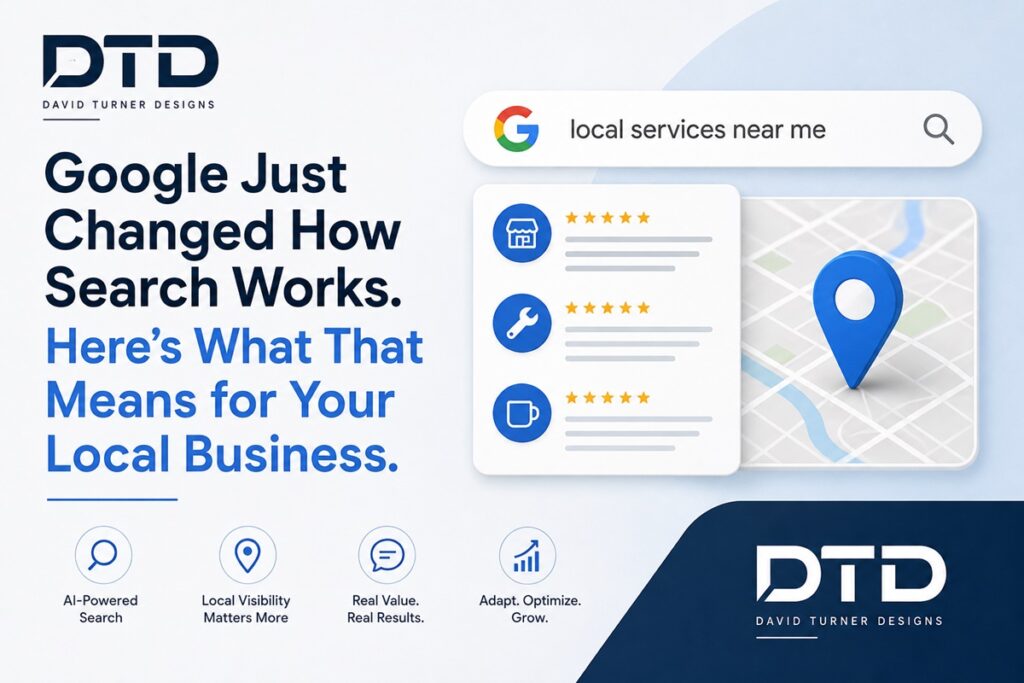
At I/O 2026, Google rolled out “AI Mode,” a redesign of search built around AI that answers questions right on the results page. Instead of acting like a phone book that points to businesses, Google is trying to be the person who just answers your question. That means fewer people click through to any website.
The numbers in the original coverage were striking: about 60% of Google searches now end without a click to any website, and for “near me” searches, the ones your local customers use, it’s as high as 78%.
Three I/O announcements that matter for local businesses
Google’s AI can call your business for a customer
For some service categories, including home repair, beauty and pet care, Google’s AI can now place a phone call to a business on a customer’s behalf to check availability and pricing. If a homeowner asks Google to find an HVAC tech for Friday, the AI may call your shop. If your number is wrong, your voicemail is full or nobody answers, it moves on to the next listing, and you never know you lost the job.
Results are getting personal
Google’s “Personal Intelligence” connects AI search to a person’s Gmail, Photos and Calendar. Two neighbors searching for the same thing can get different answers based on their own history. If a customer has emailed you, left you a review or saved your number, you’re more likely to come up for them. Staying in touch with past customers now pays off in search, too.
People search in full sentences now
The old way: “roofer Gastonia NC.” The new way: “I need a roofer in Gastonia who can do a free estimate this week and has good reviews for storm damage.” Google’s AI answers questions like that by pulling from your website, your Google Business Profile and your reviews at the same time. A site that just says “we do roofing” doesn’t give it much to work with.
What this means for a contractor or small shop
I don’t want to oversell the scare. The businesses getting hit hardest are giant national websites that live on blog traffic from strangers. Your HVAC company or downtown sandwich shop doesn’t. But three things do affect you:
AI is deciding who gets recommended. When someone asks Google, ChatGPT or another AI tool “who’s the best roofer near Gastonia?”, it names a handful of businesses. If you’re not on that short list, you’re not in the conversation.
Your star rating works like a filter. The coverage I read put ChatGPT’s cutoff around 4.3 stars, Perplexity’s around 4.1 and Gemini’s around 3.9. Google Maps would show a nearby 3.5-star business; AI tools may skip it entirely.
The people who do click are serious. Visitors who click through after reading an AI answer have already done their research. That same coverage reported them converting at roughly 14%, compared with about 3% from regular Google results. Fewer visits, better visits.
What to do now
Treat your Google Business Profile like your most important page
It feeds the AI, it’s where your reviews live, and for many searches it matters more than your website. List every service, add recent photos, keep your hours accurate including holidays, post updates and reply to every review.
Get serious about your review average
Asking feels awkward. Do it anyway. Text recent customers a direct link to your review page after a job well done. Aim for 4.3 stars or better. If old bad reviews are dragging you down, a steady stream of new good ones is the most reliable fix.
Make your website answer questions
- A separate page for each service you offer
- The towns and counties you serve, named clearly
- Honest answers to common questions, like what a job costs and how long it takes
- The same phone number and address as your Google listing
- Fast loading on a phone
Add structured data
Structured data (also called schema markup) is a little behind-the-scenes code that tells Google exactly what kind of business you are, where you are and how to reach you. Think of it as a cheat sheet for the AI. For my clients, it’s part of every website build.
Get your phone ready for AI calls
Answer professionally, keep your voicemail box clear, and make sure the greeting says your business name. If an AI agent calls to check availability and hits a full mailbox or a generic greeting, it moves on.
Measure calls, not just clicks
Fewer website visitors doesn’t automatically mean your marketing is failing. People may be calling you straight from Google. Track calls, form requests, foot traffic and revenue. If those are steady or growing, your online presence is doing its job.
Keep a presence outside Google
Google is keeping more people inside Google, so have some reach it doesn’t control: a Facebook page with real posts, an email list of past customers, Nextdoor for neighborhood work, and plain old word of mouth.
The big picture
Search isn’t dead, and Google isn’t going away. The fundamentals haven’t changed: do good work, earn good reviews, look professional online and be easy to reach. What’s changed is which of those matter most and how the tools around them work. The businesses that adjust early will have the edge.
Quick answers
Do I need a new website for AI search? Not always. Many fixes, like clearer service pages, FAQs and structured data, can be added to the site you have. If it’s very old, a rebuild may be faster.
Can anyone guarantee ChatGPT will recommend me? No one honestly can. What I can do is give AI tools every reason to understand and trust your business, and show you how they describe you before and after.
Not sure how your business looks to AI search? Let’s have a plain-talk look at where you stand and what, if anything, makes sense to do next.
Keep reading
- AI Search: how I help businesses get recommended by ChatGPT and Google AI answers
- How Google Local Search Works in 2026: A Plain-Talk Guide for Local Businesses
- Why Your Google Business Profile Suddenly Matters More Than Your Website
Want help with this? Start a project or call 980.291.3232. I answer my own phone.